

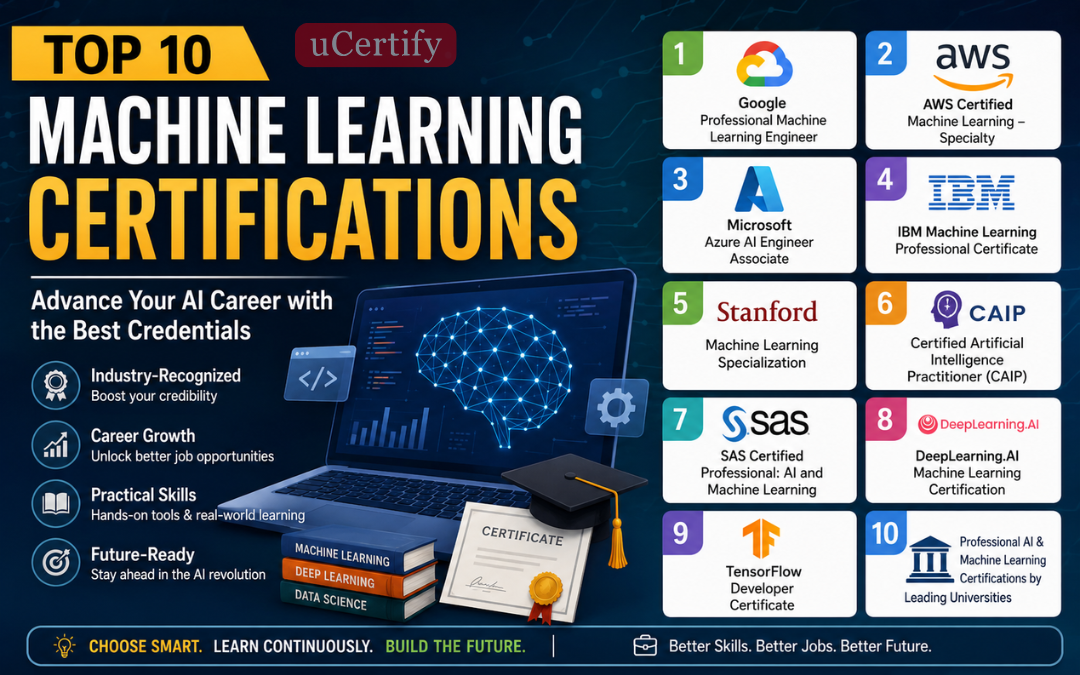
Why Top Machine Learning Certifications Matter in Today’s Job Market
The demand for machine learning professionals has grown rapidly across industries, from healthcare and finance to retail and manufacturing. Organizations are actively searching for professionals who can develop predictive models, automate processes, and extract insights from large datasets. While practical experience remains essential, earning one of the Top Machine Learning Certifications can help candidates validate their skills and stand out in a competitive job market. Certifications provide structured learning paths, industry-recognized credentials, and exposure to real-world machine learning concepts. Whether you are a beginner looking to enter the field or an experienced professional aiming to advance your career, the right certification can demonstrate your commitment to continuous learning and technical excellence. Many employers also consider certifications as evidence of specialized knowledge in machine learning frameworks, algorithms, and AI technologies.
By the end of this guide, you’ll understand which certification best matches your experience level, career goals, and preferred technology ecosystem. You’ll also learn the strengths of each certification and how they fit into today’s AI job market.
Top Machine Learning Certifications Comparison Table (2026)
| Certification | Platform / Provider | Experience Level | 2026 Core Focus | Best For |
| Google Professional Machine Learning Engineer | Google Cloud | Intermediate–Advanced | Production ML, Vertex AI, MLOps | AI Engineers |
| AWS Certified Machine Learning – Specialty | AWS | Intermediate–Advanced | SageMaker, Enterprise ML | Cloud Professionals |
| Microsoft Azure AI Engineer Associate | Microsoft Azure | Intermediate | Azure AI & Cognitive Services | Enterprise AI Engineers |
| IBM Machine Learning Professional Certificate | IBM | Beginner–Intermediate | Python & Machine Learning Fundamentals | Beginners |
| Stanford & DeepLearning.AI Machine Learning Specialization | Coursera | Beginner–Intermediate | Core ML Algorithms & Theory | Students & Career Changers |
| Certified Artificial Intelligence Practitioner (CAIP) | CertNexus | Intermediate | Vendor-Neutral AI | AI Consultants |
| SAS Certified Professional: AI and Machine Learning | SAS | Intermediate–Advanced | Enterprise Analytics | Regulated Industries |
| Databricks Certified Machine Learning Professional | Databricks | Intermediate | Spark, MLflow & Lakehouse | Data Engineers |
| DeepLearning.AI Generative AI with LLMs | DeepLearning.AI | Intermediate | LLMs, RAG & Prompt Engineering | GenAI Engineers |
| Linux Foundation MLOps Associate | Linux Foundation | Beginner–Intermediate | Kubernetes, CI/CD & ML Deployment | MLOps Engineers |
How to Choose the Right Machine Learning Certification
Choosing from the many available Top Machine Learning Certifications depends on your career goals, technical background, and the technologies used in your target industry. Before selecting a certification, ask yourself three questions:
- Are you new to machine learning or already working in AI?
- Do you want to specialize in cloud platforms, enterprise analytics, or Generative AI?
- Which technologies are commonly used by employers in your preferred industry?
Answering these questions will help you invest your time and money in a certification that aligns with your long-term career objectives.
Google Cloud, AWS, or Azure: Which Platform Should You Choose?
Many professionals struggle to decide between the three leading cloud certifications. While all three are respected, they serve slightly different career paths.
Google Cloud is often preferred by AI-first startups and organizations building production machine learning pipelines with Vertex AI. It is an excellent choice for professionals interested in end-to-end machine learning deployment and MLOps.
AWS continues to dominate enterprise cloud infrastructure. If your goal is to work with large organizations using Amazon SageMaker and enterprise-scale machine learning workflows, AWS remains one of the strongest choices.
Microsoft Azure is widely adopted by enterprises already invested in Microsoft’s ecosystem. Organizations deploying Azure OpenAI Service and Microsoft AI solutions frequently seek professionals with Azure AI expertise.
1. Google Professional Machine Learning Engineer Certification
The Google Professional Machine Learning Engineer Certification is widely respected among employers and technology professionals. This certification focuses on designing, building, and productionizing machine learning models using Google Cloud technologies. Candidates learn how to prepare data, train models, optimize performance, and deploy machine learning solutions at scale.
One of the reasons this certification consistently appears among the Top Machine Learning Certifications is its emphasis on real-world production environments. Rather than focusing only on model development, it evaluates a professional’s ability to manage the complete machine learning lifecycle, including deployment, monitoring, and optimization. Organizations adopting MLOps practices often value these skills because they directly impact production-ready AI systems.
Experience Level: Intermediate to Advanced
Core Tools Taught: Vertex AI, BigQuery, TensorFlow, Google Cloud Platform
Ideal For: Machine Learning Engineers, AI Architects, Cloud AI Professionals
2. AWS Certified Machine Learning – Specialty
Amazon Web Services offers a specialized certification for professionals who work with machine learning solutions in cloud environments. The AWS Certified Machine Learning – Specialty certification covers data engineering, exploratory data analysis, modeling, and machine learning implementation. Participants gain knowledge of AWS machine learning services and learn how to create scalable AI solutions.
This AI and Machine Learning Certification is particularly valuable for professionals working with enterprise cloud infrastructure. Since many organizations rely on AWS for production workloads, certified professionals often have opportunities to work on large-scale machine learning deployments involving automated pipelines, model monitoring, and cloud-native AI services.
Experience Level: Intermediate to Advanced
Core Tools Taught: Amazon SageMaker, AWS Glue, Athena, EC2
Ideal For: Data Scientists, Cloud Engineers, Machine Learning Engineers
3. Microsoft Azure AI Engineer Associate
Microsoft’s Azure AI Engineer Associate certification is designed for professionals who build, manage, and deploy AI solutions using Azure services. The curriculum includes machine learning, computer vision, natural language processing, and conversational AI technologies. Candidates learn how to integrate artificial intelligence into business applications while leveraging Microsoft’s cloud platform.
Many enterprises already operate within the Microsoft ecosystem, making Azure AI expertise highly valuable. Professionals pursuing this Machine Learning Career Certification gain experience working with Azure Machine Learning and Azure Cognitive Services while learning how to deploy secure AI applications within enterprise environments.
Experience Level: Intermediate
Core Tools Taught: Azure Machine Learning, Azure Cognitive Services, Azure AI Studio
Ideal For: AI Engineers, Cloud Professionals, Solution Architects
4. IBM Machine Learning Professional Certificate
The IBM Machine Learning Professional Certificate provides a comprehensive introduction to machine learning concepts and applications. It covers supervised learning, unsupervised learning, deep learning fundamentals, feature engineering, and model evaluation techniques. Learners also gain practical experience using Python and popular machine learning libraries through hands-on exercises.
For professionals entering the AI field, this certification offers an excellent balance between theory and practical implementation. It is especially suitable for career changers because it focuses on developing real-world skills while building confidence with widely used machine learning tools.
Experience Level: Beginner to Intermediate
Core Tools Taught: Python, Scikit-learn, Pandas, Jupyter Notebook
Ideal For: Beginners, Career Changers, Junior Data Scientists
5. Stanford & DeepLearning.AI Machine Learning Specialization
Rather than treating these as separate certifications, it is important to recognize that the Stanford & DeepLearning.AI Machine Learning Specialization, created by Andrew Ng, represents one of the most influential learning pathways in modern machine learning education. It introduces supervised learning, unsupervised learning, neural networks, recommendation systems, and machine learning best practices through a carefully structured curriculum.
This specialization is widely regarded as a foundational stepping stone for aspiring machine learning professionals because it focuses on understanding the underlying concepts behind machine learning algorithms instead of simply teaching software tools. Many learners complete this certification before pursuing cloud-specific credentials from Google, AWS, or Microsoft.
Experience Level: Beginner to Intermediate
Core Tools Taught: Python, Machine Learning Algorithms, Neural Networks
Ideal For: Students, Aspiring Machine Learning Engineers, Career Changers
6. Certified Artificial Intelligence Practitioner (CAIP)
The Certified Artificial Intelligence Practitioner (CAIP) certification is designed for professionals who want a broad understanding of artificial intelligence technologies, including machine learning. Unlike certifications tied to a single cloud platform, CAIP provides vendor-neutral knowledge that can be applied across different industries and technology stacks.
The certification covers machine learning methodologies, neural networks, natural language processing, AI governance, and implementation strategies. This flexibility makes it attractive to professionals who lead AI initiatives, advise organizations on AI adoption, or work across multiple technology ecosystems rather than specializing in a single cloud provider.
Experience Level: Intermediate
Core Tools Taught: AI Frameworks, Machine Learning Methodologies, Data Analytics Concepts
Ideal For: AI Consultants, Technology Leaders, Project Managers
7. SAS Certified Professional: AI and Machine Learning
Although SAS is no longer the first choice for most AI engineering roles, it continues to hold significant value in regulated industries such as banking, healthcare, insurance, pharmaceuticals, and government organizations. Many enterprises in these sectors continue to rely on SAS for predictive analytics, risk modeling, and regulatory reporting.
The SAS Certified Professional: AI and Machine Learning certification focuses on predictive modeling, advanced analytics, model validation, and enterprise-scale data analysis. Professionals working in organizations with established SAS environments can benefit from this certification because it demonstrates expertise in building reliable, compliant, and production-ready analytical models.
Experience Level: Intermediate to Advanced
Core Tools Taught: SAS Viya, SAS Analytics, Predictive Modeling Tools
Ideal For: Data Analysts, Business Intelligence Professionals, Analytics Specialists working in regulated industries
8. Databricks Certified Machine Learning Professional
Databricks has become one of the fastest-growing platforms for enterprise machine learning by combining big data processing with scalable AI development. Organizations building modern AI solutions increasingly rely on the Lakehouse architecture, Apache Spark, and MLflow to manage large-scale machine learning workflows.
The Databricks Certified Machine Learning Professional certification validates a candidate’s ability to prepare large datasets, train machine learning models, manage experiments, and deploy models within enterprise environments. It is particularly valuable for professionals working with big data pipelines where machine learning models depend on high-quality, scalable data engineering.
Experience Level: Intermediate
Core Tools Taught: Apache Spark, MLflow, Databricks Lakehouse Platform
Ideal For: Machine Learning Engineers, Data Engineers, Data Scientists
9. DeepLearning.AI Generative AI with LLMs
Generative AI has rapidly become one of the most sought-after areas in artificial intelligence. While traditional machine learning remains essential, many organizations are now investing heavily in Large Language Models (LLMs), Retrieval-Augmented Generation (RAG), AI assistants, and intelligent automation.
The DeepLearning.AI Generative AI with LLMs certification introduces learners to the concepts behind foundation models, prompt engineering, fine-tuning strategies, Retrieval-Augmented Generation (RAG), model evaluation, and responsible AI practices. As businesses continue integrating generative AI into products and internal workflows, professionals with these skills are increasingly in demand.
Experience Level: Intermediate
Core Tools Taught: Large Language Models (LLMs), Prompt Engineering, Amazon Bedrock, Retrieval-Augmented Generation (RAG)
Ideal For: AI Engineers, GenAI Developers, Machine Learning Professionals transitioning into Generative AI
10. Linux Foundation MLOps Associate
Building an accurate machine learning model is only one part of delivering successful AI solutions. Organizations also need professionals who can deploy, monitor, maintain, and continuously improve those models in production environments. This growing discipline is known as Machine Learning Operations (MLOps).
The Linux Foundation MLOps Associate certification focuses on the operational side of machine learning by introducing continuous integration and deployment (CI/CD), containerization, Kubernetes, version control, model monitoring, and infrastructure automation. As organizations increasingly adopt production AI systems, MLOps skills have become highly valuable for engineering teams responsible for scalable machine learning deployments.
Experience Level: Beginner to Intermediate
Core Tools Taught: Kubernetes, Docker, GitOps, CI/CD Pipelines, MLflow
Ideal For: MLOps Engineers, DevOps Engineers, Machine Learning Engineers
Heading Of The CTA
_(3)_0012Pw.webp)
Interactive Learning Awaits You
Gamify your prep with bite-sized chapters, interactive lessons & much more!
Learn MoreCommon Misconception About Machine Learning Certifications
A common misconception is that earning a certification alone guarantees a machine learning job. In reality, employers evaluate candidates based on a combination of technical skills, practical projects, problem-solving ability, and professional experience. Certifications validate knowledge and demonstrate commitment to continuous learning, but a strong portfolio showcasing real-world machine learning or AI projects often has an equally significant impact during the hiring process.
For example, a candidate with a Google Professional Machine Learning Engineer Certification and a portfolio featuring production-ready machine learning projects is generally more competitive than someone who holds multiple certifications without practical implementation experience. Treat certifications as part of your overall career development strategy rather than the final destination.
Key Takeaways
Choosing from the available Top Machine Learning Certifications depends on your current experience, career aspirations, and preferred technology ecosystem.
- If you are a beginner, certifications such as the IBM Machine Learning Professional Certificate and the Stanford & DeepLearning.AI Machine Learning Specialization provide an excellent foundation in machine learning concepts and Python-based development.
- Professionals aiming to work in cloud environments should consider the Google Professional Machine Learning Engineer, AWS Certified Machine Learning – Specialty, or Microsoft Azure AI Engineer Associate, depending on the platforms commonly used by their target employers.
- If your career goals include enterprise-scale machine learning and big data, the Databricks Certified Machine Learning Professional offers valuable expertise in Spark, MLflow, and Lakehouse architecture.
- Professionals interested in the latest advancements in AI should explore the DeepLearning.AI Generative AI with LLMs certification to develop practical skills in prompt engineering, Retrieval-Augmented Generation (RAG), and Large Language Models.
- Those responsible for deploying and maintaining production machine learning systems can strengthen their expertise through the Linux Foundation MLOps Associate certification.
- Finally, professionals working in highly regulated sectors such as healthcare, banking, insurance, and government may still find the SAS Certified Professional: AI and Machine Learning highly relevant because of its continued enterprise adoption in those industries.
Choosing the Right Machine Learning Certification for Career Growth
Selecting the right Top Machine Learning Certifications ultimately comes down to your career objectives, technical background, and the skills employers value within your chosen field. Cloud-focused certifications from Google, AWS, and Microsoft remain excellent choices for professionals building enterprise AI solutions, while certifications from Databricks and the Linux Foundation address the growing importance of scalable data pipelines and production-ready machine learning systems. At the same time, certifications focused on Generative AI help professionals stay aligned with one of the fastest-evolving areas of artificial intelligence.
The most valuable Machine Learning Certificate Programs are those that combine hands-on experience, industry recognition, and practical application. Rather than pursuing multiple certifications at once, focus on earning a Machine Learning Career Certification that aligns with your current skill level and complements a portfolio of real-world projects. Combining verified expertise with practical implementation will significantly improve your ability to stand out in today’s competitive AI job market while preparing you for long-term career growth in machine learning and artificial intelligence.
_0010QY.webp)
_0011NL.webp)
No Comments Yet
Be the first to share your thoughts on this post!